Before you buy your first private property in Singapore, check three things: whether you can buy (HDB owners must finish their Minimum Occupation Period first), how much you can borrow (MAS caps all your monthly debt repayments at 55% of gross income, and a first housing loan at 75% of the property's value), and how much cash you need on day one (at least 5% of the price in cash, plus Buyer's Stamp Duty and any Additional Buyer's Stamp Duty within 14 days of signing). Get those three right and the rest is a sequence of documents: an Option to Purchase, a Sale and Purchase Agreement, then completion or, for a new launch, staged payments until you collect the keys.
This guide walks a first time home buyer in Singapore through each step for private property: who can buy, the loan and CPF rules, stamp duty, the buying process for resale and new launch homes, and the costs that are easy to miss. Every rule here comes from IRAS, MAS, CPF, HDB, SLA, URA, CEA or BCA, checked on 3 November 2026.
Who can buy what
Citizens, permanent residents and foreigners
Anyone can buy a condominium unit. Under the Residential Property Act, a "foreign person" is anyone who is not a Singapore citizen (or a Singapore company, LLP or society), so permanent residents count too. A foreign person can buy a condominium unit or a flat in a private development without approval, but needs approval from the Singapore Land Authority for landed homes such as terraces, semi-detached houses and bungalows.
What changes with your profile is the stamp duty. A Singapore citizen buying a first home pays no ABSD; a permanent resident pays 5%; a foreigner pays 60%. The full table is in the stamp duty section below.
If you own an HDB flat
HDB flat owners cannot buy private residential property, in Singapore or overseas, until the flat's Minimum Occupation Period (MOP) is over. The MOP is 5 years for Standard and other flats, and 10 years for Plus and Prime flats. The rule covers the owners and the occupiers listed on the flat. Your own MOP date is on My HDBPage.
After the MOP, a Singapore citizen who keeps the flat and buys a condo is buying a second property: that means 20% ABSD, and a lower loan limit if the HDB loan is still outstanding. Both are covered below. Our upcoming guide on upgrading from HDB to a condo goes through the timeline and cash flow.
Your budget: what you can borrow and what you pay in cash
The 55% debt cap (TDSR)
The Total Debt Servicing Ratio (TDSR) caps all your monthly debt repayments, including the new housing loan, at 55% of your gross monthly income. Banks don't use today's interest rate for this test: they apply a stress-test rate no lower than a floor set by MAS, so the loan you qualify for is usually smaller than a simple repayment calculation suggests. Ask the bank for an in-principle approval before you pay any booking or option fee.
A second cap, the Mortgage Servicing Ratio (30% of gross income), applies only to loans for HDB flats and executive condominiums still within their MOP. It does not apply to a private condo.
Loan-to-value and the down payment
The loan-to-value (LTV) limit sets how much of the property's value the bank can lend. For individuals, MAS sets these limits:
| Housing loans you already have | LTV limit | Minimum cash down payment |
|---|---|---|
| None | 75% (or 55%) | 5% (10% at the 55% limit) |
| One | 45% (or 25%) | 25% |
| Two or more | 35% (or 15%) | 25% |
The lower figure applies if the loan tenure is longer than 30 years, or if the loan runs past age 65. The longest tenure for a private property loan is 35 years.
For a first-time buyer with no other loan, a 75% loan leaves a 25% down payment: at least 5% in cash, and the other 20% from cash or CPF. The second row is the one HDB upgraders miss. If the HDB loan is still outstanding when you buy, the bank can lend only 45%, and at least 25% of the price must be in cash.
Using your CPF
Your CPF Ordinary Account (OA) can pay part of the down payment after the 5% cash minimum, and the monthly instalments after that. Any part of the price above the valuation must be paid in cash. For a bank loan, CPF usage is capped at the lower of the price and the valuation. Beyond that cap you can use up to 120% of it, but only if you have set aside your Basic Retirement Sum. The full amount is available only if the property's remaining lease covers the youngest buyer to age 95; a shorter lease lowers the limit. The CPF housing calculator gives the figure for your case.
Our upcoming guide on TDSR, LTV and mortgage basics works through the loan numbers in more detail.
Stamp duty at a glance
Buyer's Stamp Duty (BSD) is charged on the higher of the price or the market value, at these rates (in force since 15 February 2023):
| Portion of the price or value | BSD rate |
|---|---|
| First $180,000 | 1% |
| Next $180,000 | 2% |
| Next $640,000 | 3% |
| Next $500,000 | 4% |
| Next $1,500,000 | 5% |
| Above $3,000,000 | 6% |
On a $1.5 million home, that works out to $44,600 of BSD.
Additional Buyer's Stamp Duty (ABSD) comes on top, by buyer profile (rates in force since 27 April 2023):
| Buyer | First home | Second home | Third and later |
|---|---|---|---|
| Singapore citizen | 0% | 20% | 30% |
| Permanent resident | 5% | 30% | 35% |
| Foreigner | 60% | 60% | 60% |
Both are due to IRAS within 14 days of signing the contract, or 30 days if it is signed overseas. For a new launch, that is the S&P agreement. CPF OA savings can cover BSD and ABSD, but usually as a reimbursement: you pay the duty in cash first and claim it back from CPF later. A married couple buying their second home together may get the ABSD refunded if they sell their first home within 6 months of buying a completed home, or within 6 months of TOP for one still being built, subject to IRAS's conditions. Our upcoming stamp duty guide covers BSD and ABSD in more detail.
The buying process
Buying a resale condo
The seller grants you an Option to Purchase (OTP) in return for an option fee. You exercise the option within the option period, usually by paying an exercise fee and signing, and the Sale and Purchase Agreement then binds both sides. Completion follows on the agreed date, when the balance is paid and the title passes to you. The fee amounts and the time periods are set in the contract between you and the seller, and CEA publishes standard OTP and S&P templates you can use. A conveyancing lawyer handles the transfer and the CPF and loan paperwork.
Buying a new launch from a developer
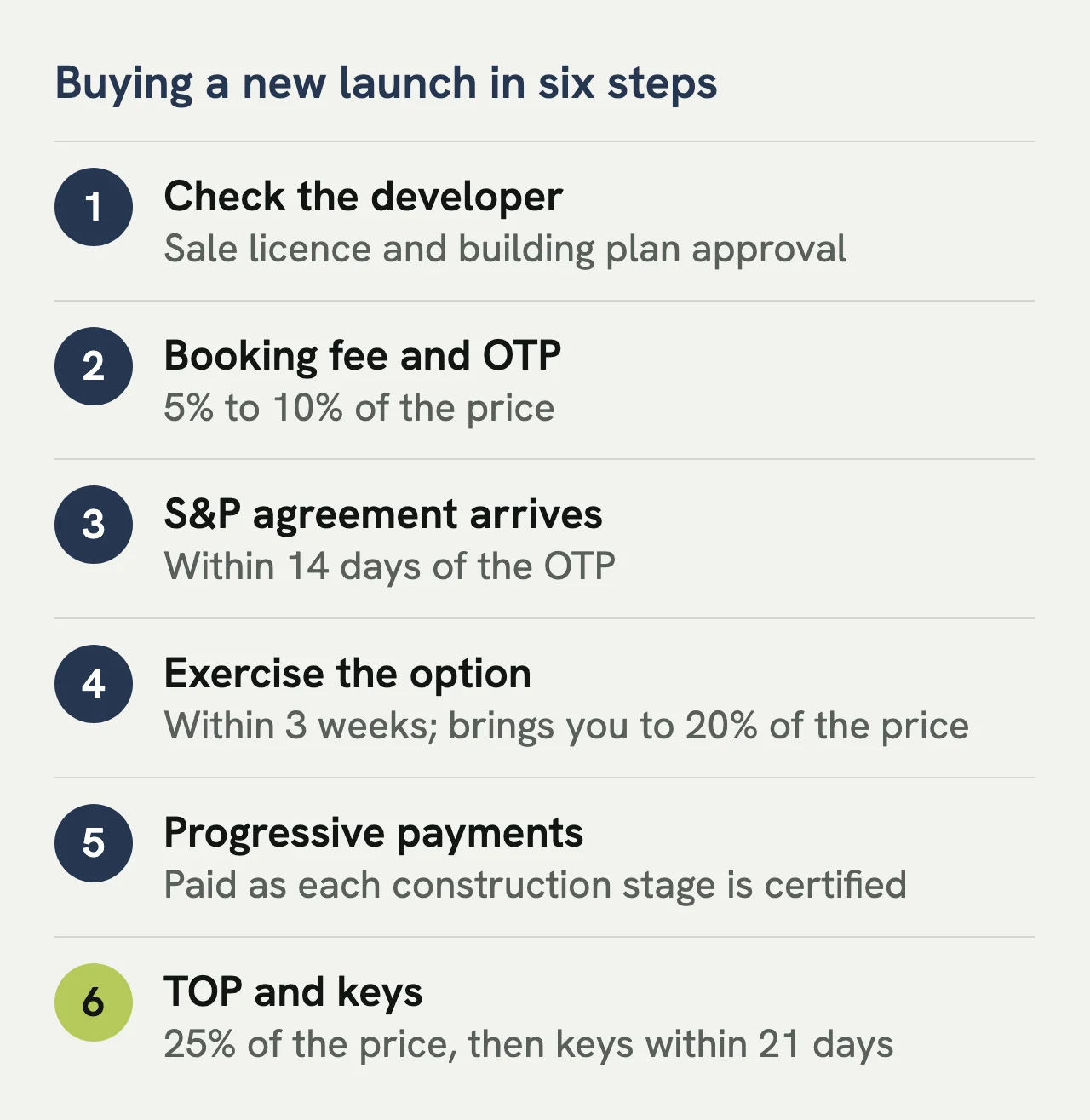
URA's Home Buyers' Guide sets out the steps for a home that is still being built:
- Check the developer. A project of more than 4 units can only be sold by a developer with a sale licence and building plan approval. You can check the licence on URA's website.
- Booking fee and OTP. You pay a booking fee of 5% to 10% of the price, and the developer grants you an OTP. Review the unit's floor plan, the site plan and the specifications before this step. The OTP cannot be passed to anyone else, so every buyer must be named on it.
- S&P agreement. The developer must deliver the S&P agreement and title documents within 14 days of the OTP.
- Exercise. You have 3 weeks from delivery to sign and pay the balance down payment: 20% of the price less the booking fee. The developer may allow up to 8 weeks from the OTP date to pay it. If you let the option lapse, the developer may keep 25% of the booking fee and refund the rest.
- Progressive payments. The rest is paid in stages as construction is certified. Late payments carry interest under the S&P agreement. If an instalment stays unpaid more than 14 days after it is due, the developer can annul the agreement and keep 20% of the price.
- TOP and keys. A payment of 25% of the price falls due when the Temporary Occupation Permit (TOP) is issued and the roads, drainage and sewerage serving the project are done. The developer must hand over the unit within 21 days of receiving it, and by the date in the S&P agreement.
Our upcoming guide covers how progressive payments work. To choose between the two routes, see new launch or resale: which suits you. If you are weighing a specific area, our guide to living in Lorong Chuan shows the kind of checks worth making on transport, shops and schools.
Costs people forget
Beyond the price and the stamp duty, budget for:
- Legal and conveyancing fees. Agree the scope and the fee with your lawyer first. CPF OA can pay legal fees.
- Valuation and loan-related fees. Ask the bank and the valuer what they charge.
- Maintenance contributions. In a condo, owners pay regular contributions to the management corporation for the upkeep of common property and facilities and for future major works. BCA notes the amount is usually reviewed every year at the AGM, and the by-laws bind every owner. CPF savings cannot pay these.
- Seller's Stamp Duty if plans change. If you sell within 4 years of buying (for purchases on or after 4 July 2025), Seller's Stamp Duty applies: 16% in the first year, then 12%, 8% and 4%.
The first three are quotes rather than fixed rules, so get them in writing before you commit.
A first-timer's checklist
- Confirm your MOP date on My HDBPage, if you own an HDB flat.
- Get an in-principle approval from a bank, so you know your TDSR and loan limit.
- Check your CPF OA balance and the CPF housing calculator for your usage limit.
- Work out BSD and any ABSD, and set aside the cash to pay it within 14 days.
- Hold at least 5% of the price in cash for the down payment (25% if you still have a housing loan).
- Appoint a conveyancing lawyer before you sign an OTP.
- For a new launch, check the developer's sale licence and read the floor plans and site plan.
- Keep a cash buffer for fees and maintenance contributions.
Every buyer's situation is different. Speak to a bank about your loan, and to a conveyancing lawyer before you sign an OTP.
A new launch in Lorong Chuan
One Chuan Grove is a 99-year leasehold development of approximately 1,056 homes off Lorong Chuan in Serangoon, about a 3-minute walk from Lorong Chuan MRT on the Circle Line. A preview is targeted for 13 February 2027. See the floor plans you review before booking, or register your interest and receive the price list and floor plans first, when the developer releases them, ahead of the preview.
This guide is general information, not financial, legal or tax advice. Rules and rates change; check them with the source shown, your bank or your lawyer before you commit.